Key Takeaways:
- The new EU–U.S. reciprocal trade framework eliminates tariffs on U.S. industrial goods and guarantees $750 billion in U.S. energy offtake, tightening economic and energy interdependence.
- The deal accelerates Europe’s shift from Russian pipeline gas toward U.S. LNG imports, while raising medium-term energy costs across the EU.
- Despite diversification efforts, the EU’s energy vulnerability persists, risking renewed dependence patterns similar to those after Crimea.
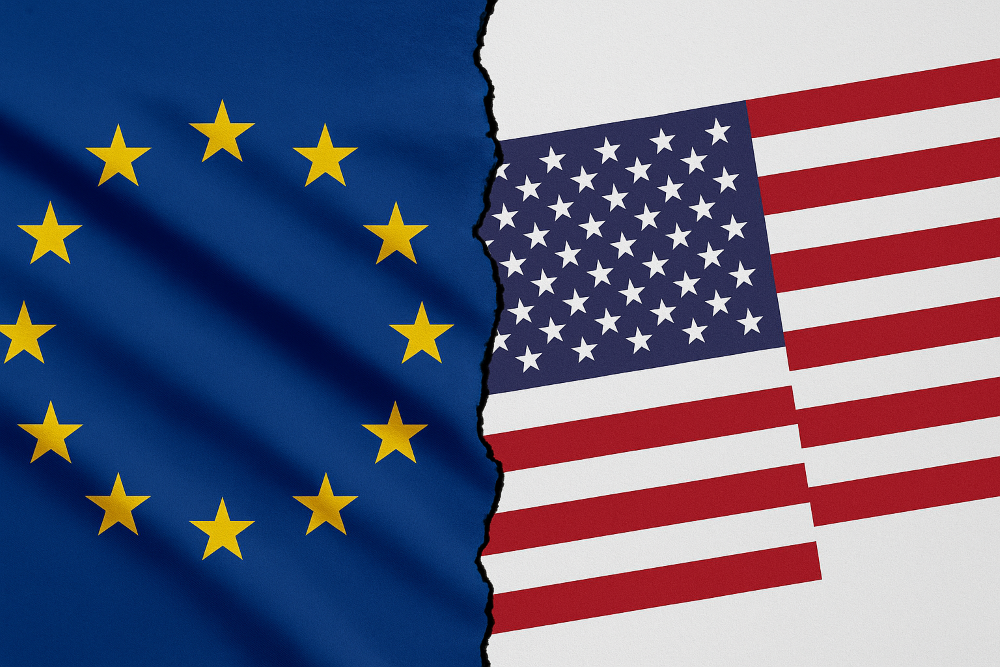
On 21 August 2025 the EU and US issued a “Joint Statement on a United States-European Union framework on an agreement on reciprocal, fair and balanced trade”. The EU intends to eliminate tariffs on all US industrial goods and provide preferential access for many US agricultural and seafood products. The US commits to apply the higher of its MFN (most-favoured-nation) tariff rate or a 15% rate on originating EU goods, with exceptions (e.g., natural resources, aircraft, generics) as of 1 Sept 2025. On the energy side, the agreement explicitly states that the US and EU will cooperate on secure, reliable and diversified energy supplies, and the EU intends to procure US energy products with an expected offtake valued at US$750 billion through 2028.
Prior to the Russian invasion of Ukraine in
February 2022, Russia was the EU’s largest supplier of natural gas, crude oil,
and coal. In 2021, approximately 40% of the EU’s total gas imports originated
from Russia, amounting to around 155 billion cubic meters (bcm). The supply infrastructure included
major pipelines such as Nord Stream 1, Yamal–Europe,
the Ukraine transit corridor, and TurkStream. Germany, Italy, Austria, and
several Central and Eastern European states were among the most dependent, with
some countries sourcing over 80–90% of their natural gas from Russia. In 2021,
Russia supplied roughly 25–27% of the EU’s crude oil imports and nearly 45–50% of total EU coal imports.
The idea of importing natural gas from Russia
to Western European countries was first attempted in 1966 by Italy’s
state-owned energy company ENI. However, the negotiations for importing Russian
natural gas failed as concerns were raised within the Western bloc about
potential security threats. The first natural gas pipeline from Russia to a
European country was built in 1967, reaching Czechoslovakia, which at the time
was part of the socialist bloc. In 1968, Austria’s energy company OMV signed a
long-term contract with the Soviet Union for natural gas imports. The
full-scale import of Soviet natural gas to Western Europe began in 1970, when
West Germany’s Ruhrgas signed a gas import agreement with the Soviet Union.
Finally, in 1973, Soviet natural gas was supplied to West Germany for the first
time.
After the end of the Cold War, Russia’s
state-owned gas company Gazprom, which had been burdened by its domestic
low-price energy policy, began to actively expand gas exports to Western
Europe. The volume of gas exports from Russia to Western Europe grew
significantly from 6.8 billion cubic meters in 1973 to 110 billion cubic meters
in 1990. The main reason Russian natural gas achieved such a high market share
in the EU’s gas market was its price competitiveness. Russian gas was exported
to Western Europe at prices 10–20% lower each year than those of Algeria, one
of the region’s major gas suppliers. Under these circumstances, Western
Europe’s dependence on Russian natural gas gradually deepened after the end of
the Cold War.
However, even before the war in Ukraine,
pipeline natural gas (PNG) imported from Russia to the EU had repeatedly faced
supply-security problems. In 2006, 2009, and 2014, disputes between Russia and
Ukraine disrupted the flow of natural gas from Russia to the EU via Ukrainian
transit routes. In late December 2021, Russia halted natural gas supplies
through the Yamal–Europe pipeline, which carries gas to the EU via Belarus and
Poland.
Following Russia’s illegal annexation of
Crimea in 2014, the EU imposed sanctions on Russia; nevertheless, the EU’s
dependence on energy imports from Russia did not decrease—indeed, it grew. This
was not only because the EU could secure relatively inexpensive energy by
purchasing Russian resources, but also because Western European companies stood
to gain direct and indirect economic benefits. For example, The Nord Stream 1 pipeline
project’s equity is distributed as follows: Gazprom International Projects North
1 LLC (Russia), 51%; Wintershall Dea AG (Germany), 15.5%; PEG Infrastruktur AG (E.ON) (Germany), 15.5%; N.V. Nederlandse Gasunie (the Netherlands),
9%; and ENGIE (France), 9%.
Even before Russia’s invasion of Ukraine, the
United States consistently opposed the “Nord Stream 2” pipeline project—which
expanded the existing “Nord Stream 1” pipeline transporting natural gas from
Russia to Germany through the seabed—on the grounds that it would increase
Europe’s dependence on Russian gas and worsen Ukraine’s energy security, as
many of the existing pipelines supplying EU member states from Russia pass
through Ukraine. Both the Obama administration and the Trump’s 1st
administration maintained a consistent stance against the project. President
Joe Biden also initially opposed the pipeline, arguing that it would expand
Russia’s influence over Europe. However, prioritizing the restoration of
U.S.–Europe relations damaged during the Trump’s first administration, the
Biden administration conditionally approved the Nord Stream 2 pipeline in July
2021. However, on February 22, 2022, Germany suspended the pipeline’s
certification in response to the Russian invasion of Ukraine.
Prior to the onset of the war in Ukraine, the
EU relied predominantly on pipeline natural gas (PNG) for its supply;
consequently, LNG terminals were operated only by a limited set of countries:
Greece, Malta, Italy, Spain, Portugal, France, Belgium, the Netherlands,
Poland, and Lithuania. Germany, for example, which relied on Russian natural
gas for more than 50% of its imports before the war, did not operate any LNG
terminals at that time. The lack of LNG terminals in most EU member states was
mainly due to the higher market price of LNG compared to pipeline gas. Since it
was relatively easy for EU countries to secure pipeline gas supplies from
Russia, Norway, and Algeria, they preferred the PNG mode of import.
Since the outbreak of the war in Ukraine, the EU has rapidly expanded its LNG terminals through the deployment of Floating Storage Regasification Units (FSRUs). As the EU committed to increasing its purchases of U.S. energy resources in the course of EU-U.S. tariff negotiations, the use of FSRUs for LNG terminals within the EU is expected to grow further. Consequently, positive spillover effects on orders for the Korean shipbuilding industry are anticipated.
After the outbreak of the war in Ukraine, the
EU unveiled the REPowerEU Plan on 18 May 2022 to reduce its dependence on
Russian fossil fuels. The plan aims to diversify energy supply chains, curb
energy consumption, and accelerate the transition to clean energy; in
particular, it seeks to diversify the import routes for natural gas.
Despite the EU’s REPowerEU plan, the EU’s
natural gas imports from Russia increased in 2024 compared with 2023. In 2023,
the EU imported 87.8 bcm from Norway, 56.2 bcm from the United States, and 42.9
bcm from Russia; in 2024 it imported 91.1 bcm from Norway, 45.1 bcm from the
United States, and 51.7 bcm from Russia. As a result, Russia overtook the
United States in 2024 to become the EU’s second-largest supplier of natural
gas. The share of LNG in the EU’s gas imports jumped from 23% in 2021 (before
the war in Ukraine) to 42% in 2024 (after the outbreak of the war). Because LNG
typically commands a higher supply price than pipeline gas (PNG), EU gas supply
prices have surged. Until 2020, when gas supply stability was maintained,
Europe’s natural gas prices—owing to its heavy reliance on PNG—were about half
those in East Asia; now they are at roughly comparable levels. This has
negatively affected the EU’s natural-gas-based power generation and industrial
production. Depending on how circumstances develop, there is a possibility that
a situation similar to the post-Crimea pattern could recur—where EU sanctions
initially reduced reliance on Russian gas but were eventually followed by a
renewed surge in dependence.
At present, the United States’ largest export
product to the EU is crude oil, and natural gas and refined petroleum products
likewise rank among the top ten U.S. export products to the EU. This means
that, if the war in Ukraine were to end, the EU could reduce its reliance on
U.S. energy imports—an outcome directly tied to U.S. trade gains. In this
context, the EU–U.S. tariff negotiations included a provision under which the
EU would import $750 billion worth of energy from the United States through 2028
(i.e., within President Trump’s term). In those tariff talks, the EU secured
favorable tariff rates for its exports to the United States; however, this also
resulted in a situation in which natural gas supply prices within the EU are
likely to remain elevated over the medium to long term, much as they are now.