- #China
- #North Korea
- #Security & Defense
Key Takeaways:
1. The
Russia-Ukraine War has degraded the security environment in Asia as well as in
Europe.
2. The War handed North Korea a strategic windfall. The DPRK adroitly exploited first Russia’s need for assistance against Ukraine and then China’s fear of Russia passing.
3. Due to the tightening trilateral ties between Beijing, Moscow, and Pyongyang, Seoul and Washington face greater war and escalation risks on the Korean Peninsula.
The Ukrainian Stalemate
Despite massive casualties, huge
economic costs, and many prospective mediators, the Russian government obstinately clings to the
same war aims that Moscow declared even before launching its full-scale invasion of Ukraine on February 24, 2022. Putin
continues to seek through diplomacy gains the Russian military has proven
unable to achieve on the battlefield, aiming to render Ukraine critically
vulnerable to future Russian aggression.
Specifically, Moscow demands that Ukraine cede all of Crimea, Donetsk,
Kherson, Lugansk, and Zaporizhzhia to the Russian Federation (amounting to
one-fifth of Ukraine’s internationally recognized territory), limit its armed
forces, abandon its aspirations to join NATO, and “de-NAZify” its regime by
removing anti-Russian leaders from power. Russian representatives insist that
Western governments accept these Ukrainian concessions and address the “root
causes” of Russia’s insecurity by limiting NATO-Ukrainian defense ties, rescinding
Western sanctions, and curtailing NATO military activities near Russia.
Ukraine and its
major Western backers resolutely reject these demands. Their strategy is to
sustain the Ukrainian military, boost European defense production, and intensify
economic pressure on Russia. Whereas the West counts on eventual Russian
exhaustion, the Kremlin anticipates Western war weariness and transatlantic
divisions will ultimately sap Ukrainian resistance.
The Russia-Ukraine War will likely continue until new
leaders take power in Moscow or Kyiv who are both able and willing to make
major concessions.
Korean
Ripples
North Korea
has been a prime beneficiary of the Russia-Ukraine
War. Once weak and isolated, Pyongyang now enjoys considerably better military,
diplomatic, and economic prospects.
Moscow’s
invasion of Ukraine supercharged its relationship with Pyongyang. After failing to negotiate a nuclear
deal with Washington during Trump’s first term, the DPRK leadership determined
to strengthen its military capacity and ties with Russia.
In a remarkably parallel manner, the
two Korean states leveraged their large arms industries to support belligerents
in the Russia-Ukraine war. Russia, Ukraine, and NATO members suffered from major munitions shortfalls due to the unexpected duration of the
conflict and the challenges they encountered transitioning to a wartime footing.
As Nicolas Jouan recently wrote in Korea on Point, South Korea rapidly became a crucial weapons source for European
countries by providing NATO-compatible systems on favorable terms. Similarly, the
DPRK drew on its large stockpiles of Soviet-compatible munitions—such as
artillery shells, short-range ballistic missiles, anti-tank weapons, and other
weaponry—to become a
major supplier of the Russian military.
However, the North went further and sent more than ten thousand elite soldiers to combat the
Ukrainian troops occupying parts of Russia’s Kursk province. Moreover, the DPRK provided Russia with thousands
of North Korean workers in violation of UN Security Council resolutions. Their
employment released Russian citizens for military service and other purposes.
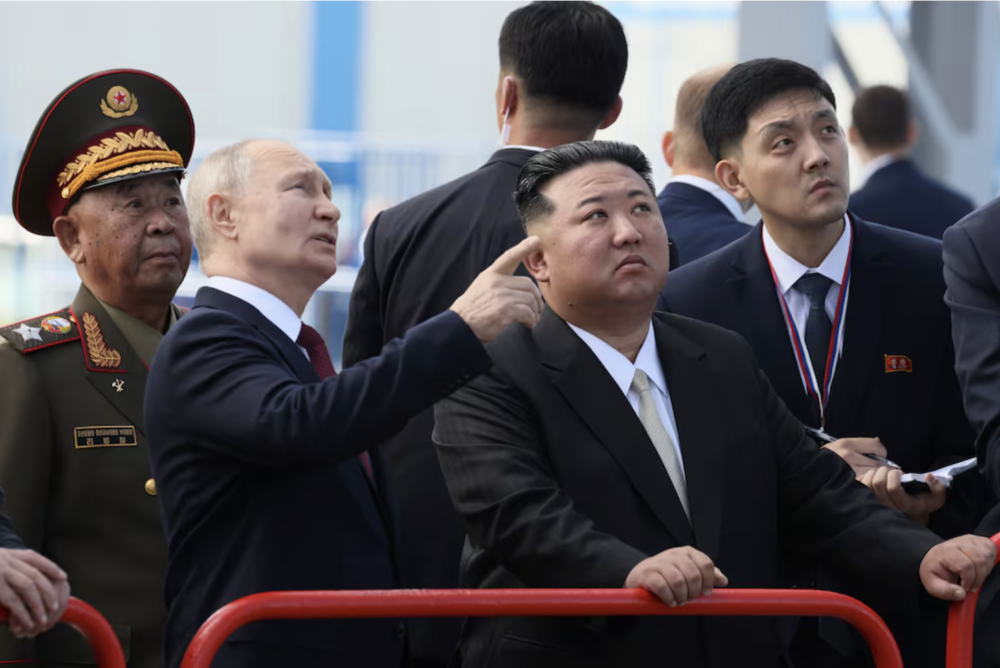
The deployment of thousands of DPRK
troops to European Russia represented an unprecedented development for the
Continent’s security. It also elevated the North’s status to the apex of
Moscow’s hierarchy of defense partners.
The DPRK troops who
fought for Russia have gained invaluable operational experience in fighting
modern wars, such as how to conduct logistically complex operations in
electronic warfare-intensive environments with the proliferation of small drones.
The North’s military complex is striving to diffuse throughout the Korean People’s Army (KPA). The war has also provided the KPA with unparalleled opportunities to field
test the North’s missiles and other weapons.
Additionally, the
Russian and North Korean governments signed a new mutual security treaty that provided for
more comprehensive security cooperation than their defunct Cold War pact. The Kremlin no longer contests the DPRK’s claims to be a de facto nuclear
weapons state.
Furthermore, Russian entities have substantially advanced the North’s military
modernization. The DPRK can leverage its newly fortified defense industrial
base both for its own rearmament and to sell weapons to additional foreign
clients besides Russia.
Trilateral Troubles
Before 2025, the connections between China, Russia, and
North Korea were primarily bilateral rather than trilateral. While Russia and
North Korea had developed substantial military ties, the PRC had pursued mostly
economic cooperation with Pyongyang.
Beijing’s
unease over the Russia-DPRK defense partnership were evident in PRC officials’
aversion to discussing the alignment publicly and in the limited number of
trilateral military activities. Analysts speculated that Beijing resented
Russia’s displacing China as the North’s primary political-military partner.
But Kim Jong-un’s attendance at the September 2025
PLA Victory Parade restored senior Sino-DPRK diplomatic exchanges.
The Chinese-Russian-DPRK leadership engagements at the event implied Beijing’s
acceptance of the Moscow-Pyongyang defense alignment. The absence of the
traditionally declared goal of Korean Peninsula denuclearization in PRC-DPRK
statements further suggested that Chinese leaders have joined their Russian
counterparts in concluding that the North will retain its nuclear weapons indefinitely.
Beijing’s
motivations for restoring ties with the Kim regime reflect an assessment that
the PRC would incur excessive costs in openly opposing the DPRK-Russian defense
partnership or the North’s nuclear program.
For its
part, Pyongyang regularized relations with Beijing to sustain economic ties
with China, which vastly exceed those with Russia. Closer DPRK-PRC relations also
helps Pyongyang hedge against an upswing in PRC-ROK, PRC-U.S., or Russian-U.S.
ties—or an end to the Russian-Ukraine War. Any of these developments could
decrease Moscow’s interest in sustaining its atypical partnership with the North.
Even if that war continues, the growth of Russian defense production may
decrease its need for North Korean assistance.
For now, with backing from China and Russia, the DPRK enjoys more leverage to negotiate on the nuclear issue. For instance, Beijing’s and Moscow’s circumvention of extant international sanctions and resistance to new ones have deprived Seoul and Washington of opportunities to pressure Pyongyang by tightening sanctions or to entice better DPRK behavior by offering sanctions relief. The decreased pressure on Pyongyang to denuclearize, along with Ukrainian buyers’ remorse about surrendering its legacy nuclear forces and Russian manipulation of nuclear war risks to constrain NATO support for Ukraine, could further spur nuclear proliferation, especially in Northeast Asia.
Rising War Risks
The strengthening security ties between
China, Russia, and North Korea—fueled by the Russia-Ukraine War—have elevated
the risks of miscalculation, deterrence failure, and war on the Korean
Peninsula. The North’s strengthened combat capabilities, along with Beijing’s
and Moscow’s stronger backing, could make the DPRK leadership more risk
tolerant.
Meanwhile, the potential for Chinese or Russian military intervention in any Korean
conflict has risen. In the case of a war with the United States, China or Russia
might preemptively attack the U.S. bases in South Korea, while the DPRK might contemplate
opportunistic aggression, perhaps encouraged by Beijing or Moscow to further
strain U.S. resources.
Richard Weitz is senior fellow and director of the Center for Political-Military Analysis at Hudson Institute. His current research includes regional security developments relating to Europe, Eurasia, and East Asia as well as US foreign and defense policies.