- #Energy & Climate
- #US-ROK Alliance

Key Takeaways
- this report argues for a strategic pivot from a "sovereignty" paradigm, which frames the relationship around rights and restrictions, to a "capability" paradigm, which measures success by the advanced, secure nuclear technologies the two nations can jointly develop and deploy.
- The simultaneous failure of the top-down HLBC and the disappearance of the bottom-up I-NERI has effectively "hollowed out" the institutional architecture, leaving the partnership reliant on short-term commercial deals and devoid of a long-term strategic mechanism.
- to fill the vacuum left by I-NERI, the two governments should establish a new, formally chartered ROK-U.S. Nuclear Futures Initiative.
Introduction
Recent discourse on ROK-U.S. nuclear cooperation has been dominated by calls to amend the “Agreement for Cooperation Concerning Peaceful Uses of Nuclear Energy," commonly known as the "123 Agreement." While this legal framework is an essential foundation for cooperation, an overemphasis on its text risks obscuring a more fundamental truth: the partnership's true strength and future potential are defined not by diplomatic formalism, but by substantive, project-based achievements. The 2015 agreement, in particular, was designed to facilitate continuous negotiation and created practical channels for peaceful nuclear activities, most notably the High-Level Bilateral Commission (HLBC). It is puzzling, therefore, that while this attractive mechanism – the HLBC – has remained dormant for years, there are growing calls to revise the very agreement that created it.
While securing "peaceful nuclear sovereignty" through legal articles is a desirable goal, protracted and tedious negotiations can inadvertently stall the progress they seek to enable. To prevent this, a pragmatic approach centered on tangible, collaborative projects is necessary. We must operate a framework that builds trust, creates shared capabilities, and delivers concrete benefits that reinforce the alliance. Therefore, this report argues for a strategic pivot from a "sovereignty" paradigm, which frames the relationship around rights and restrictions, to a "capability" paradigm, which measures success by the advanced, secure nuclear technologies the two nations can jointly develop and deploy. Through an analysis of past successes, a diagnosis of current institutional stagnation, and a blueprint for a revitalized, project-centric framework, this report will demonstrate that a resilient partnership must be built on a foundation of consistent, substantive cooperation.
A Legacy of Successful ROK-U.S. Nuclear Leadership
The ROK-U.S. partnership has a proven record of leveraging joint projects to achieve global leadership in nuclear security and non-proliferation. This model of combining diplomatic initiative with tangible technical contributions provides a powerful template for future engagement.
Following President Barack Obama's 2009 Prague speech advocating for a "world without nuclear weapons," the Republic of Korea hosted the second Nuclear Security Summit in 2012, transforming from a participant in the global nuclear world to a leader shaping its future. This was not merely ceremonial. Seoul actively drove an agenda focused on practical, action-oriented outcomes, as codified in the Seoul Communiqué. This focus on measurable progress moved the global dialogue from aspiration to implementation. The 2012 summit's diplomatic success was amplified by a landmark technical announcement. As a "gift basket," the ROK participated a joint project among the ROK, U.S., France, and Belgium to develop high-density Low-Enriched Uranium (LEU) fuel, leveraging a high-density LEU manufacturing technology that the Korea Atomic Energy Research Institute (KAERI) uniquely possesses worldwide. This initiative, based on KAERI's atomization method, provided a viable technical pathway to convert high-performance research reactors from HEU to LEU fuel. It directly addressed one of the summit's core objectives – the minimization of civilian HEU – and substantively contributed to the conversion of research reactors in Europe and Japan.
|
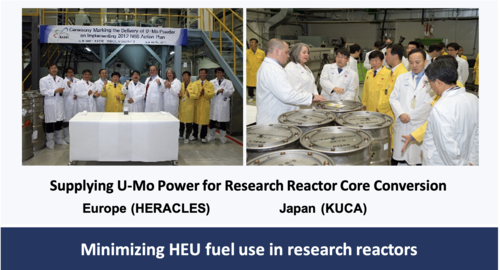
This program was a prime example of how collaborative R&D can have a more profound and lasting impact on global security than purely diplomatic declarations. It showcased Korea's capability to provide an innovative solution to a pressing global proliferation challenge and represented a key ROK-U.S. cooperative achievement that greatly strengthened the US global non-proliferation regime.
Furthermore, the summit's legacy was institutionalized through the establishment of a Center of Excellence in the ROK, which became the Nuclear Security Training and Education Center (INSA). INSA provides practical training to international experts, directly contributing to the IAEA mission and strengthening the global security architecture.
Recent Cooperation Development
When the ROK and U.S. first signed an agreement in 1956, Korea's primary objective was to adopt U.S. technology. Now, nearly 70 years later, the historical dynamic has fundamentally transformed. Today, the partnership is one between peers, marked by a two-way flow of technology and deep integration of complementary strengths. A remarkable moment in this evolution is the contract awarded to a KAERI-led consortium to design the NextGen Missouri University Research Reactor (MURR). The project, aimed at producing critical medical radioisotopes like lutetium-177 for cancer treatment, signifies a "reverse-export" of nuclear technology adopted from the United States. This marks the first time a Korean-designed reactor has been selected for a project in the United States. Having once imported its first reactors from the U.S., the ROK has matured into a world-class nuclear supplier. The significance of this achievement is that it fundamentally reframes the alliance as a partnership of equals. This project also exemplifies a new, integrated model of cooperation. The U.S. National Nuclear Security Administration’s (NNSA) Proliferation Resistance Optimization (PRO-X) program will be applied to this reactor's development. Unlike traditional safeguards applied after construction, PRO-X embeds non-proliferation and security features directly into the design phase. The application of PRO-X to a Korean-designed reactor demonstrates a fusion of the two countries' core competencies: the ROK's advanced reactor design and manufacturing combined with U.S. leadership in non-proliferation science. This synergy creates a powerful "gold standard" offering for the global market – a high-performance, cost-effective reactor that is inherently secure by design. This integrated approach provides a significant competitive advantage over state-owned Russian and Chinese export models, allowing the ROK-U.S. partnership to champion higher non-proliferation standards globally.
A Proposal for the Future
Despite these successful cases of cooperation, the formal architecture meant to guide the partnership has fallen into disuse, creating a strategic vacuum and risking a loss of long-term coherence.
The HLBC, established by the 2015 Agreement as the senior-level steering committee for cooperation on spent fuel management, exports, fuel supply, and security, has been dormant for over eight years. This prolonged hiatus highlights the framework's vulnerability. This stagnation was driven by a confluence of factors: strategic misalignment from the ROK's nuclear phase-out policy, industrial friction over intellectual property (IP) issues between Westinghouse and KHNP, broader alliance friction under the Trump administration over trade and cost-sharing, and the diversion of diplomatic bandwidth to the North Korean nuclear crisis and escalating U.S.-China competition. Concurrently, successful bottom-up R&D frameworks have been allowed to atrophy. The International Nuclear Energy Research Initiative (I-NERI), a highly effective model for fostering bilateral research, concluded in 2024 without a direct institutional successor. This has left a critical gap in structured, working-level R&D collaboration. The simultaneous failure of the top-down HLBC and the disappearance of the bottom-up I-NERI has effectively "hollowed out" the institutional architecture, leaving the partnership reliant on short-term commercial deals and devoid of a long-term strategic mechanism. To reverse this institutional decay and build a more resilient partnership, a new framework is needed – one that mandates regular engagement and prioritizes the execution of concrete, jointly-funded projects.
First of all, the HLBC must be reformed to ensure consistency. Its terms of reference should be amended to mandate annual meetings, insulating it from the political whims that led to its dormancy. Its primary function should shift from high-level negotiation to strategic oversight and the active removal of bureaucratic obstacles impeding joint projects at the working level. Second, to fill the vacuum left by I-NERI, the two governments should establish a new, formally chartered ROK-U.S. Nuclear Futures Initiative. Co-managed by the U.S. Department of Energy (DOE) and the ROK Ministry of Science and ICT (MSIT), this initiative would serve as an executive body for joint projects. Its defining feature would be a dedicated, jointly-funded R&D budget, allowing it to solicit, fund, and manage multi-year collaborative projects. This structure would institutionalize cooperation at the technical level, providing a stable engine for innovation insulated from high-level political volatility.
Conclusion
A resilient ROK-U.S. nuclear partnership cannot be taken for granted. The dormancy of the HLBC is a stark warning against relying on politically sensitive, high-level frameworks alone. The path forward lies in institutionalizing the kind of substantive, project-based cooperation that has been the hallmark of the alliance's greatest successes. In an era of renewed great power competition, a robust ROK-U.S. technology alliance in the nuclear sphere is a strategic imperative. By jointly developing and deploying the next generation of nuclear technology, the two nations can set the global standards for safety, security, and non-proliferation, providing a credible, democratic alternative to the state-directed offerings of Russia and China. Through a revitalized and project-driven framework, the ROK and the United States can co-lead a global nuclear renaissance, accelerating the deployment of advanced reactors to meet climate goals, collaboratively solving the challenges of the nuclear fuel cycle, and strengthening the international non-proliferation regime through technological leadership. The partnership's focus must shift from negotiating constraints to building the future, together. This is the path "Towards Resilient U.S.-Korea Strengthened Ties" (TRUST).
Dr. Eunju Jun is the Director for International Strategy at the Korea Atomic Energy Research Institute (KAERI) and served as the Chair of the Education and Training Working Group of the Generation-IV International Forum. She was also the science attaché at the Embassy of the Republic of Korea in Austria. She holds a B.S., M.S and Ph.D. in nuclear engineering from the Korea Advanced Institute of Science and Technology.