Key Takeaways:
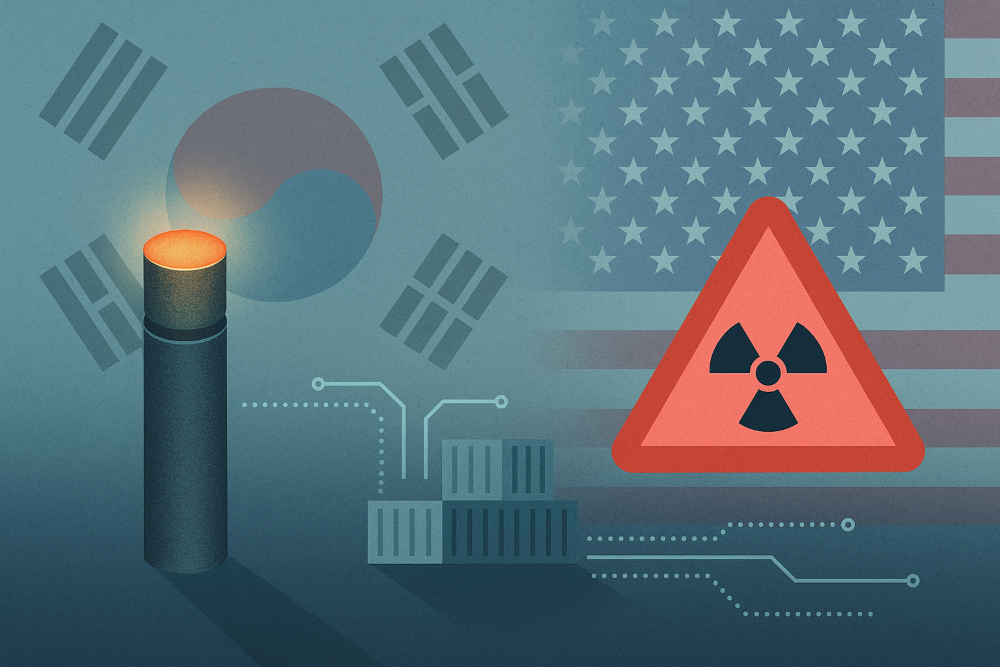
- South Korea’s push for uranium enrichment risks being framed as a strategic or proliferation move because the dialogue is being led by its National Security Office instead of civilian ministries.
- To avoid U.S. suspicion and secure cooperation, enrichment must be reframed as a fuel supply stability issue and embedded within a joint ROK–U.S. export model, not an independent strategic hedge.
- Transparent governance — separating technical, security, and diplomatic roles — is essential to turn enrichment from a “red flag” into alliance-based infrastructure that strengthens both energy security and strategic trust.
The current ROK-US discussions on uranium enrichment are aimed
at determining the extent to which South Korea will be able to secure domestic nuclear
fuel cycle capabilities and fuel supply stability. The problem is that these
talks are being led by Korea’s National Security Office (NSO), rather than by
the Ministry of Climate, Energy, and Environment based on cost and
supply-demand reviews. The government claims that "enrichment is a
civilian issue," but the structure of having the security control tower at
the forefront of this dialogue sends a different signal. To the United States,
this raises suspicions: "Does South Korea have ulterior motives for
independently securing key fuel cycle processes?" Consequently, the issue
is being elevated from a technical and economic matter to a political and
proliferation problem.
This also creates a domestic contradiction. The current
administration advocates for an energy transition characterized by
"reducing nuclear power and expanding renewable energy." However,
simultaneously discussing domestic enrichment infrastructure and fuel
self-sufficiency sends a mixed message: expanding investment in the nuclear
fuel cycle even as demand is supposedly decreasing. The government may argue,
"Fuel security is necessary as long as nuclear plants are operating,"
but external observers interpret this as an "accumulation of strategic
options rather than a power supply issue." When combined with the
discourse on "self-reliant defense," enrichment immediately escalates
into questions about nuclear-powered submarines, independent deterrence, and
even the alliance structure itself. At this point, enrichment is no longer a
simple fuel supply issue; it becomes a subject of U.S. concern about "what
options South Korea is preparing," and the unintended result is that South
Korea becomes a target of non-proliferation monitoring.
If the dialogue continues under this framing, South Korea’s
mentions of enrichment will be setting off non-proliferation alarm bells in
Washington. This could result in other technical agendas—such as SMR (Small
Modular Reactor) fuel supply and cooperation on spent nuclear fuel storage and
disposal—becoming subject to unwarranted political scrutiny. In other words,
the more Seoul pushes the domestic logic that "it is necessary for
security," the more likely it becomes that these other parallel
workstreams fail to gain traction in Washington. To change this, a reframing is
necessary. This means positioning enrichment and fuel cycle capabilities not as
a "covert strategic option," but within the context of "fuel
security, supply chain stability, and mutual ROK-US benefit." Transitioning
to this new framework will hinge on the proper execution of three key framing
strategies.
First, the problem must be defined as fuel supply stability.
The question is not "Should South Korea immediately acquire independent
enrichment capabilities?" The core questions are: "What is the actual
demand for Low-Enriched Uranium (LEU) over the coming decades? What are the
unit costs and technical/regulatory risks of meeting that demand with domestic
facilities? And can the same level of stability be secured through long-term
supply contracts, diversification of suppliers, strategic reserves, and alliance-based
mutual supply agreements?" This is a numbers-based question that the
climate ministry can calculate. In short, it is a “comparison of supply chain
scenarios to minimize fuel supply risks,” not a security narrative about “building
strategic options through independent enrichment.” Within this new framework,
the U.S. can also be a cooperative partner. Reducing an ally's fuel insecurity
stabilizes that ally's industrial base, which aligns with America's strategic
interests.
Second, enrichment and fuel cycle capabilities must be
integrated into a ROK-US joint export model. The market no longer demands just
"one reactor"; it demands an "energy security package."
This is a full-cycle bundle that includes initial fuel, long-term procurement
contracts, operational and maintenance support, regulatory and safety systems,
and the transport, storage, and disposal of spent fuel. Here, South Korea
brings construction and operational efficiency, project management skills, and
the ability to adhere to schedules. The U.S. brings global safety norms, a fuel
certification system, and non-proliferation credibility. This combination
creates a structure where the importing country buys a warranted "energy
security service," not just the equipment itself. In this context, South
Korea's enrichment and fuel cycle capabilities are interpreted not as
"South Korea independently accumulating strategic options," but as an
"alliance-based infrastructure" for which the ROK and U.S. take joint
responsibility for stable fuel supply and back-end management. The same
technology thus acquires a different diplomatic meaning.
Third, the governance structure must be rebuilt. Allowing
the NSO to lead the discussion, as is current practice, sends the wrong signal
both domestically and internationally. Domestically, the perception might be
that the dialogue is deprioritizing not only the climate ministry's cost/demand
verification and the foreign ministry's treaty and non-proliferation
management, but also the Ministry of Science and ICT's (MSIT) review of
technology and personnel ecosystems and the Nuclear Safety and Security Commission's
(NSSC) safety, security, and safeguards checks. Externally, it reinforces the
perception that "this is a matter to be handled secretly at the security
level, not as an industrial or supply chain issue." A desirable structure
would be one that institutionalizes an appropriate division of labor and
transparency. The security line must publicly state why it is in charge
of this issue now, what its goals are, and what it will not do—in other
words, it must declare its "red lines" and "non-objectives"
and be held accountable for that promise. The climate ministry should present
the cost structures and supply chain scenarios; the foreign ministry should
manage the ROK-US Atomic Energy Agreement and non-proliferation messaging; and
the MSIT and NSSC should review and disclose technical feasibility, safety, and
safeguards. The key is not to dilute authority, but to institutionally
guarantee that this project is not on a military track by transparently
documenting the basis for decisions at multiple levels.
These three pillars cannot be pursued separately. If the
fuel supply stability calculations are not presented in the language of the
climate ministry, the argument for cooperation loses its footing. If governance
is not transparently separated, no amount of data will ease U.S. wariness.
Conversely, if a structure takes hold that combines transparent governance,
data-driven comparisons from a supply chain perspective, and an explanation of
these results as a ROK-US joint export package, the enrichment and fuel cycle
debate will appear less as a "suspicious/sensitive agenda" and more
like an “infusion of stable infrastructure provided to the market by the ROK-US
alliance."
Ultimately, the goal is to transform the dynamic from
"South Korea's independent capability vs. U.S. apprehension" to one
of "fuel security and joint exports." This is a strategy to avoid the
most costly risk: a situation where the pursuit of domestic enrichment for fuel
security is paradoxically blocked by external non-proliferation suspicions.
What we must secure is not just the technology, but the structure of trust
surrounding it. By institutionalizing enrichment and fuel cycle capabilities as
transparent energy and industrial infrastructure, rather than as a covert
option, South Korea can simultaneously strengthen its energy security,
industrial competitiveness, and strategic autonomy—all while maintaining a
pristine international image.
Dr. BAIK Seung Hyuk is currently serving as a Research Fellow of the Nuclear Energy Policy Center of the Seoul National University. He worked for 34 years in government agencies such as the National Security Office, the Ministry of National Defense and the Ministry of Foreign Affairs on national defense strategy, North Korean nuclear issue, WMD response, defense cyber policy and arms control verification. His last post as a public official was the Director of the Defense Ministry's Arms Control Verification Agency. Afterwards, he joined the Korea Institute of Nuclear Nonproliferation and Control (KINAC) as Senior Research Fellow. His interest field is a Denuclearization of North Korea issue. Dr. BAIK received a Bachelor of Science in Chemistry from the Korea Military Academy; a Master of Science and a Ph.D. in Nuclear Engineering from the Oregon State University.