- #China
Key Takeaways:
- Instead of focusing on bilateral issues, China emphasized macro-level discourse such as multilateralism, the multilateral trading system, and the Asia-Pacific community.
- Given the Lee Jae-myung administration’s inclination toward improving inter-Korean relations, China intends to leverage its relations with the North in dealings with the South.
- Rather than expecting China to play a role in inter-Korean affairs, the Korean government should emphasize that North Korea’s security threats could hinder China’s pursuit of multilateralism and economic cooperation and demand that China act responsibly.
Assessment of the 2025 South Korea-China Summit
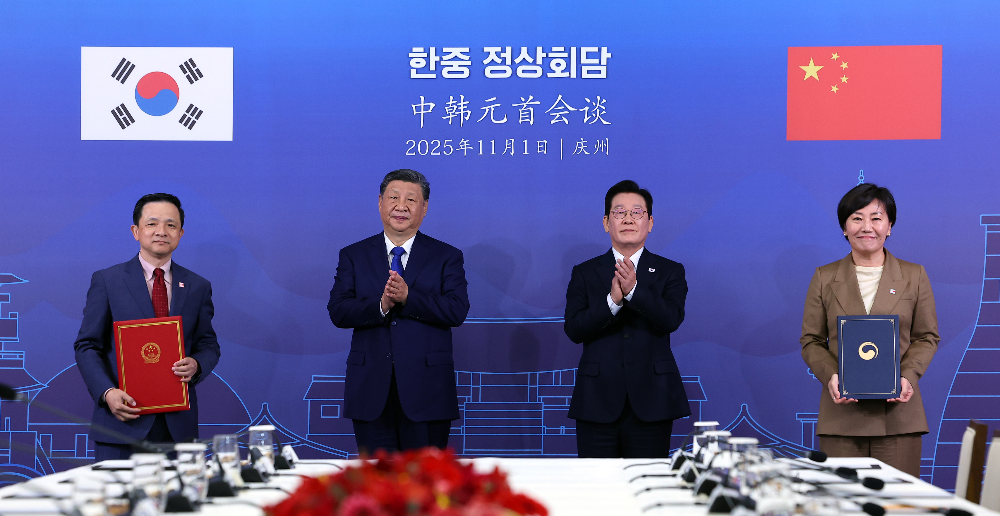
On October 30, Chinese President Xi Jinping made a state visit to South Korea on the occasion of the Asia-Pacific Economic Cooperation (APEC) summit held in Gyeongju, South Korea, in late October. Subsequently, a South Korea-China summit was held on November 1. At the summit, South Korea and China reaffirmed their “Strategic Cooperative Partnership” and signed seven Memoranda of Understanding (MOUs) on economic cooperation and public welfare. This has raised both domestic and international expectations for the expansion of economic cooperation and exchanges between the two countries and fostered a positive environment for rebuilding and developing bilateral relations going forward.
Nevertheless, the two parties failed to reach concrete agreements or outcomes on contentious issues—such as denuclearization of North Korea, China’s structures in the West Sea, its ban on Korean entertainment and export controls—revealing their disagreements on diplomacy and security. Furthermore, China implied it would approach bilateral relations with South Korea from the perspective of U.S.-China relations, emphasizing cooperation at a macro level—namely, multilateralism or the Asia-Pacific Community at the summit.
Outlook on China’s Policy Toward South Korea
Following the inauguration of the Lee Jae-myung administration, China had high expectations for the new government’s foreign policy and for the restoration of South Korea-China relations. China opposed the former Yoon Suk-yeol administration’s “values diplomacy,” perceiving it as biased in favor of the United States and aligned with Washington’s policies against China. By contrast, the Lee Jae-myung administration emphasizes flexibility in diplomacy and strategic autonomy through “national interest-oriented pragmatic diplomacy.” China therefore expects the Lee administration to adopt a different policy from its predecessor and to pursue a relatively balanced approach between the United States and China.
The Korean government raised bilateral issues such as denuclearization of North Korea, China’s activities in the West Sea, its ban on Korean entertainment and export controls during this summit. However, the Chinese government adopted an ambiguous stance, sticking to general principles. Instead of focusing on bilateral issues, China emphasized macro-level discourse such as multilateralism, the multilateral trading system, and the Asia-Pacific community.
As the second Trump administration pursues a hardline anti-China policy and indiscriminate tariffs under the slogan of “Make America Great Again (MAGA),” China is indirectly criticizing the United States and highlighting its differences by stressing multilateralism, the protection of free trade, and supply chain stability. In this context, China’s emphasis on multilateralism, free trade, regional cooperation, and common prosperity at the summit can be seen as an indirect expression that South Korea should cooperate with China to counter the protectionist policies of the second Trump administration.
Despite the Lee Jae-myung administration’s appeasement policy, North Korea maintains a hostile attitude toward South Korea. In such a situation, the Lee administration requested enhanced communication with China during the summit to resume inter-Korean dialogue. This appears aimed at gauging North Korea’s intentions or securing dialogue channels through China, which maintains cooperative relations with the North. Although a U.S.-North Korea summit did not take place during Trump’s Asia tour, the possibility of a dialogue during Donald Trump’s term is consistently raised. South Korea may have judged that improving communication with China could lead to inter-Korean dialogue and help it play a mediating role between the United States and North Korea.
However, the likelihood of China responding as South Korea intends is low. China announced Kim Jong-un’s attendance at the Victory Day parade on the same day President Lee Jae-myung returned from his visit to the United States. Moreover, China honored Kim Jong-un with the second-highest protocol at the parade and held a North Korea-China summit for the first time in six years, showing the restoration of their bilateral relations. Given the Lee Jae-myung administration’s inclination toward improving inter-Korean relations, China intends to leverage its relations with the North in dealings with the South. China can argue that South Korea should reduce, or halt ROK-U.S. and trilateral ROK-U.S.-Japan joint military exercises to create an environment conducive to U.S.-North Korea as well as inter-Korean dialogues.
Furthermore, China has strongly opposed expanding U.S.-led security cooperation in the region, out of concern that it targets China. The Trump administration has prioritized deterring and containing China in the Indo-Pacific region. To this end, it emphasizes the strategic flexibility of United States Forces Korea (USFK) in the name of “alliance modernization” and demands that South Korea expand the ROK-U.S. alliance’s scope of cooperation and participate in containing China. For China, the issue of USFK’s strategic flexibility is linked to the Taiwan issue. If the Trump administration’s unilateral demands cause cracks in its relations with South Korea and lead to a reduction of USFK troops or the transfer of wartime operational control, China will regard this as a weakening of U.S. military influence in the region. It would also interpret it as gaining greater leverage over the Taiwan issue.
Policy Implications
While this summit laid the groundwork for the improvement of South Korea-China relations, the structural issues within the relationship have deepened. China approaches South Korea from the perspective of U.S.-China relations. As a U.S. ally, South Korea must strengthen this alliance for the security of the Korean Peninsula, while simultaneously managing its relationship with China. In that respect, the Korean government should consider the following points when pursuing its China policy.
First, when strengthening strategic communication with China, South Korea must define the scope and limits of cooperation to avoid conflict with the ROK-U.S. and trilateral ROK-U.S.-Japan cooperation system. China will demand the suspension of bilateral and trilateral joint military exercises under the pretext of creating an environment conducive to inter-Korean dialogue. At the same time, China will express support for the Lee Jae-myung administration’s pursuit of strategic autonomy and attempt to pull South Korea away from the United States, thereby reducing American influence in the region. North Korea constantly demonstrates its military force—for example, by firing short-range ballistic missiles even during the APEC summit—as it seeks to establish a new Cold War dynamic and gain bargaining power in a potential U.S.-North Korea talks. To respond, South Korea should strengthen its national defense and its alliance with the United States to prevent a security vacuum on the Korean Peninsula. Amid U.S.-China strategic competition, strategic communication with China carries the risk of causing unnecessary misunderstandings among the United States and like-minded states. Therefore, South Korea must first define the scope and limits of cooperation with China before continuing strategic communication.
Second, as this summit strengthens communication between the two countries, rather than focusing on the visible outcomes of restoring South Korea-China relations, South Korea should clearly convey its concerns regarding contentious issues and demand that China clarify its position. It is by specifically understanding China’s stance and policies on each issue that South Korea can identify appropriate responses and urge China’s positive cooperation.
Third, South Korea should temper its expectations regarding China’s role in improving inter-Korean relations. The more South Korea emphasizes China’s role, the more likely Beijing is to showcase its cooperative relationship with North Korea to use it as leverage to appease and pressure South Korea. In other words, China will argue that if South Korea wants to seek to improve inter-Korean relations, it must prioritize its ties with China and focus on their cooperation, instead of leaning toward the United States. Rather than expecting China to play a role in inter-Korean affairs, the Korean government should emphasize that North Korea’s security threats could hinder China’s pursuit of multilateralism and economic cooperation and demand that China act responsibly.
Dr. Dong-gyu LEE is a research fellow of the Center for Regional Studies at the Asan Institute for Policy Studies. He is also an adjunct professor of the North-East Asian Foreign Affairs and Commerce Department at the Hankuk University of Foreign Studies (HUFS). Previously, Dr. Lee was a research fellow of the Global Security Cooperation Center at the HUFS (2015.03. ~ 2020.12.). His research focuses on Chinese politics and foreign policy, South Korea-China relations, and East Asia security. Dr. Lee received his B.A. and M.A. from the HUFS, and Ph.D. in politics from Tsinghua University in China.