- #Japan
- #US-ROK Alliance
Key Takeaways:
- The three countries should institutionalize cooperation mechanisms that channel political attention toward shared economic and security projects rather than divisive historical debates.
- One example would be to create a ‘Trilateral Economic Security Council’ for coordinating policies, which could facilitate Japanese and Korean firms working together on US projects, rather than in competition.
- Such joint industrial and R&D initiatives in shipbuilding, hydrogen, AI, semiconductors, and next-generation nuclear energy would embed the trilateral in forward-looking, mutually beneficial projects.
The election of Takaichi Sanae as Japan’s first female prime minister marks a significant moment in both Japanese domestic politics and regional diplomacy. Her ascent comes amid shifting political landscapes in Washington and Seoul—Donald Trump’s return to the White House and President Lee Jae Myung’s election—reshaping the context in which trilateral US-Japan-Korea cooperation must now be pursued.
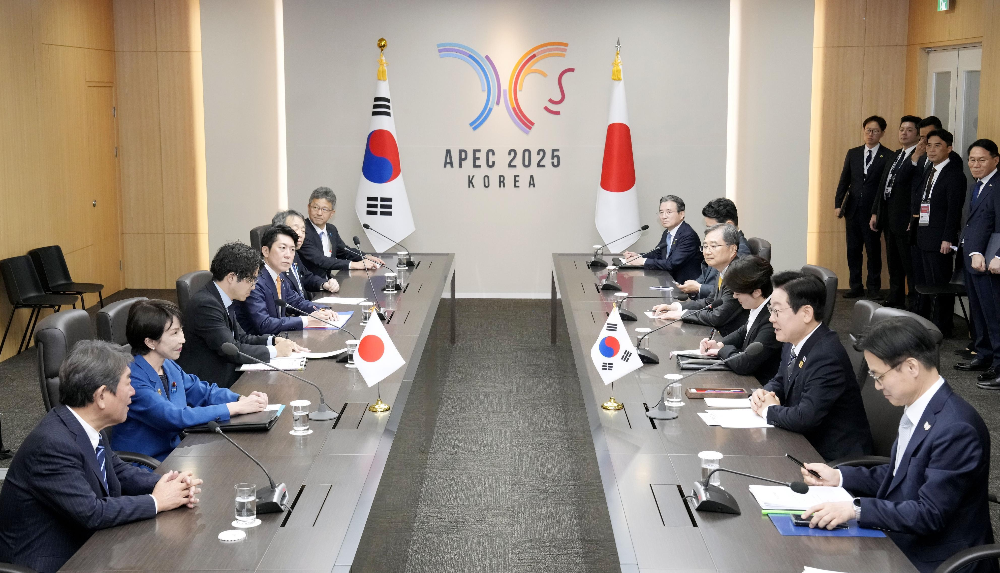
While observers initially feared that this new arrangement of leaders might disrupt the momentum of the trilateral security alliance established under their predecessors in 2023, there are signs that the relationship could not only endure but evolve, anchored by the increasingly prominent concept of “economic security”. Reframing the trilateral in this way could sustain its strategic trajectory, as it would align with Trump’s economic statecraft priorities, accommodate Takaichi’s pragmatic nationalism, and appeal to Lee’s emphasis on stability and shared prosperity. In short, an “economic security trilateral” would not only strengthen cohesion in the current geopolitical environment, it could also form a foundation for the “future-oriented” Japan-Korea relationship Takaichi and Lee presented at their recent APEC summit meeting.
This will be important, given the risk of domestic political issues undermining any of the three bilateral relationships. Trump’s return to the presidency brought back his transactional and bilateral approach to foreign relations, and his decision to impose “reciprocal” tariffs on both Japan and Korea in April 2025 to reduce persistent US trade deficits introduced an unwelcome economic dispute into the trilateral security arrangement. The situation was compounded by Takaichi’s election, as many in Seoul and Washington worried about a reversal in Japan’s recent diplomatic pragmatism. As a protégé of the late Prime Minister Abe Shinzo, Takaichi’s earlier comments on defense normalization and historical issues raised concerns in Korea, where memories of strained relations during Abe’s tenure remain vivid.
At first, these factors seemed to imperil the spirit of the trilateral. Yet following Trump’s visit to Japan and Korea, as well as the APEC summit, the picture has become more nuanced. Several developments appear to suggest that the logic of trilateral cooperation remains intact, even if its expression and emphasis are shifting.
An encouraging sign came at the UN General Assembly in September 2025, when US Secretary of State Marco Rubio met with his Japanese and Korean counterparts. Their joint statement reaffirmed the allies’ commitment to maintain deterrence against regional threats and to strengthen global engagement on security issues. But it also contained additional details on “Enhancing Economic Security and Resilience”, which underscores how deeply the economic security concept has become embedded in the trilateral framework. Among the issues covered were trilateral cooperation on supply chain resilience, energy security, digital infrastructure, critical minerals, and advanced technologies, as well as a commitment to stand firm against “economic coercion and non-market policies and practices, including export restrictions that could lead to significant supply chain disruptions”. Such language implicitly positions the trilateral against China’s proposed export control regime for rare earths.
Although the UNGA meeting occurred before Takaichi’s election, it helped institutionalize a shared vocabulary on economic security—one that aligns with all three governments’ domestic priorities. In Tokyo, Takaichi’s platform emphasizes “strategic autonomy” and the strengthening of industrial and defense capacity. In Seoul, Lee seeks stability and growth in a volatile global economy. And in Washington, Trump, Rubio, and Treasury Secretary Scott Bessent have framed US alliances in transactional, economic terms. Despite Trump’s disruption of the global trading system, economic security cooperation actually provides a common denominator that transcends ideological and partisan divides.
In this context, a second stabilizing factor is the new bilateral trade agreements between the US and its two Asian allies, concluded in July. Both Japan and Korea were able to negotiate a 15% tariff rate as part of comprehensive deals that include major strategic investment commitments ($550 billion from Japan, and $350 billion from Korea) into US industrial sectors.
These investments, covering semiconductors, shipbuilding, energy, and critical minerals, reflect a strategic “quid pro quo”. Japan and Korea gain predictable market access and a central role in US reindustrialization, while the Trump administration secures visible evidence of “ally investment” into manufacturing. Importantly, these commitments also reinforce trilateral interdependence: Japan and Korea have the same tariff rate, maintaining a level playing field; and they bring complementary strengths in high-value manufacturing and energy technology, making cooperation both economically rational and geopolitically stabilizing.
In effect, these bilateral agreements may paradoxically buttress trilateral stability. Even if Trump’s instinct is to negotiate one-on-one, the similar structure of the Japan and Korea trade deals—along with shared emphasis on economic security—creates a de facto framework for trilateral convergence.
Moreover, the emerging focus on economic security provides fertile ground for deeper Japan-Korea cooperation. Both countries face similar structural challenges, such as aging populations, industrial upgrading pressures, and exposure to Chinese economic coercion. At the same time, both are also technological powerhouses with overlapping comparative advantages in advanced manufacturing, batteries, and shipbuilding.
In conjunction with US leadership, new opportunities are arising for joint participation in supply chain diversification initiatives across Southeast Asia. Before Trump’s arrival in Japan and Korea his delegation concluded trade deals with Malaysia and Cambodia (and trade frameworks with Vietnam and Thailand)—all countries critical to the production of critical minerals and intermediate goods. Here, Japan and Korea can work together not only as suppliers to the US but as co-investors and technology partners in regional industrial ecosystems.
Similarly, Japanese and Korean excellence in shipbuilding can combine with the US push to rebuild its maritime logistics capacity to open up space for deeper trilateral industrial cooperation. Joint ventures or co-financed projects could demonstrate the tangible benefits of trilateralism, translating high-level coordination into economic deliverables. In this sense, the “economic security trilateral” concept offers not just a new narrative but a practical mechanism for aligning national strategies and business interests across the three economies. And as the Trump administration’s new slogan is “economic security is national security”, these projects might be the best way to retain his interest in enhancing the wider trilateral alliance.
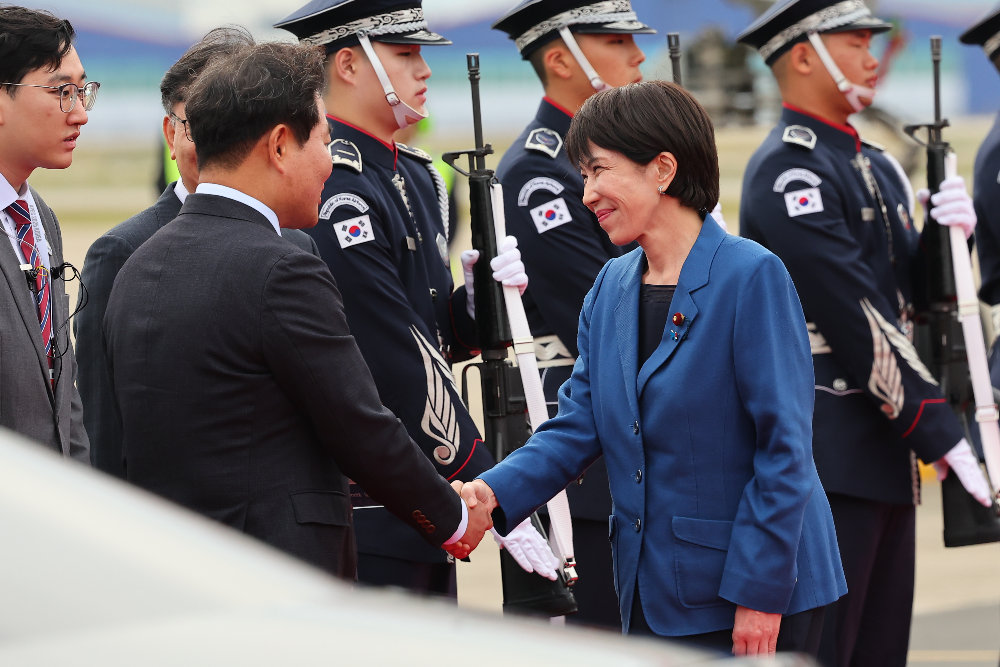
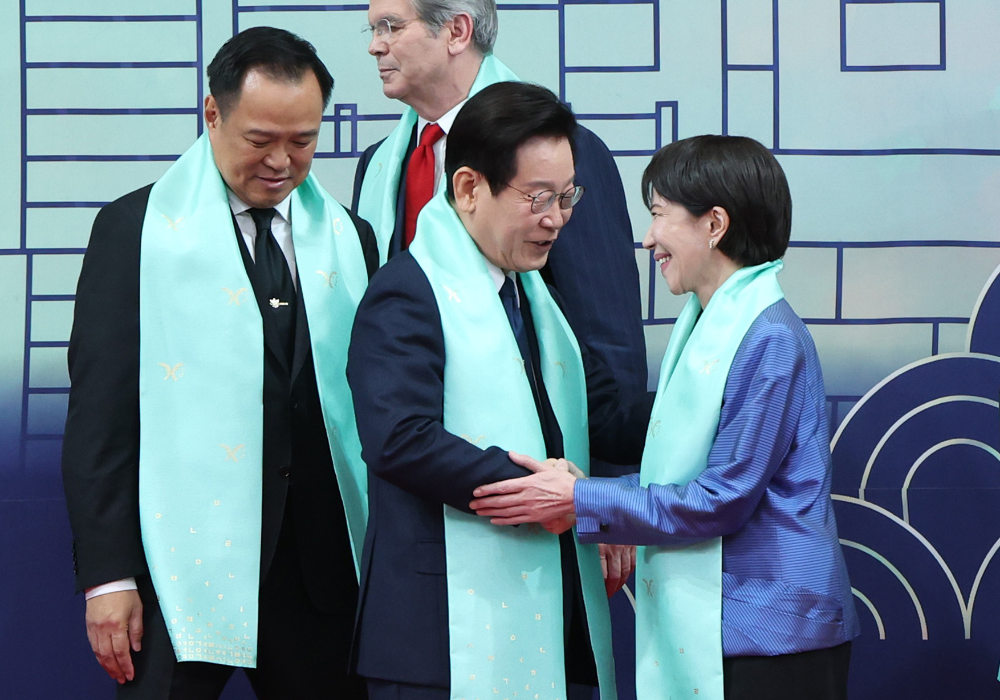
Against this backdrop, perhaps the most encouraging development came during Trump’s trip to Asia and the recent APEC summit. Takaichi and Lee were able to charm Trump, achieving a sense of stability in US-Japan and US-Korea relations that lessened the strain from the “reciprocal” tariffs episode. The first bilateral meeting between Takaichi and Lee then stabilized the third side of the trilateral. Contrary to initial expectations, their encounter was cordial and forward-looking. Both leaders pledged to pursue a “future-oriented” relationship, language that echoed the 1998 Obuchi-Kim declaration (and later efforts by former Prime Minister Kishida and President Yoon to move beyond historical disputes) rather than the more tense relations of the Abe-Moon era.
These “future-oriented” statements are significant—symbolically as well as strategically. By foregrounding leadership and stability, both Takaichi and Lee signaled an intent to manage rather than amplify nationalist tensions. For Takaichi, whose political roots lie in conservative circles, this was a notable shift toward pragmatism. For Lee, who governs from the center-left, it was an affirmation of continuity with Yoon’s external posture despite deep domestic political differences. Together, these signals suggest a mutual recognition that the bilateral relationship serves each country’s strategic and economic interests in an increasingly disordered world.
The Takaichi-Lee meeting also resulted in a joint commitment to strengthen trilateral cooperation with the US. This is important, as although Trump’s trade policies and preference for bilateralism complicate alliance management, their statement affirmed that the broader strategic environment still supports trilateral strengthening. And beyond the shared threat from North Korea, China, or Russia, the Trump administration’s principle that “economic security is national security” can reinforce shared economic strategies—if implemented wisely.
This possibility was evident in the trilateral foreign ministers’ meeting on the sidelines at APEC. If framed appropriately, Rubio, Motegi Toshimitsu, and Cho Hyun’s emphasis on energy, supply chains, and critical technologies—and Bessent’s aim of linking trade and investment commitments to broader strategic outcomes—can provide a new platform to advance the trilateral. It would then become more than a traditional alliance, and perhaps “future-oriented” in a different way: as a network of economic and technological partnerships serving the goals of US reindustrialization through allied investment; Japan-Korea relations through shared economic interests; and regional deterrence through deeper security integration.
For all this cautious optimism, the risk remains domestic politics. Both Takaichi and Lee could face pressures from their political bases to revisit unresolved historical or territorial disputes. And Trump will need to resist the urge to extract additional investments or raise tariffs on allies if he is dissatisfied with the pace of US reindustrialization. To prevent this, the three countries should institutionalize cooperation mechanisms that channel political attention toward shared economic and security projects rather than divisive historical debates.
One example would be to create a “Trilateral Economic Security Council” for coordinating policies, which could facilitate Japanese and Korean firms working together on US projects, rather than in competition. Such joint industrial and R&D initiatives in shipbuilding, hydrogen, AI, semiconductors, and next-generation nuclear energy would embed the trilateral in forward-looking, mutually beneficial projects. So would cooperation on constructing more resilient supply chains—especially for critical minerals and rare earths. In fact, a positive effect of the US-China dispute over rare earth export controls in early October is a noticeable change in Trump’s attitude towards allies, which could be leveraged in support of a deeper “economic security trilateral”.
Hopefully, “win-win” economic benefits could help the Japanese and Korean governments to build domestic constituencies for cooperation and reduce the salience of nationalism in foreign policy. With the increased economic and security challenges from China, and the US attempt to “de-risk” with the help of its allies, new economic opportunities could potentially align nationalist energy to support the trilateral, not undermine it. But it will take domestic leadership and possibly even greater US facilitation to prevent historical and territorial disputes from derailing the current “future-oriented” directionality.
In the end, the trilateral partnership has weathered political transitions and policy disruptions before, and its future sustainability will actually depend more on structural alignment rather than domestic sentiments. And that alignment now exists in the realm of economic security. The shared need to balance resilience with openness, to reduce dependence on China while maintaining competitiveness, and to integrate industrial strategy with national defense, all point toward a trilateral of necessity—one that serves the interests of all three nations even under divergent leaderships.
If Takaichi and Lee can keep their relationship “future-oriented”, and if Trump continues to frame “economic security as national security”, then the US-Japan-Korea partnership can evolve into something more durable and multidimensional. The next phase of trilateralism may even be defined as much by economic security as military security—a framework that both preserves and deepens the hard-won positive momentum of recent years.
Andrew Capistrano is a geopolitical risk consultant based in Tokyo. He is also a Visiting Research Fellow in the Economic Security Group at the Institute of Geoeconomics (IOG), and an Associate Fellow in the Algebra of International Relations (AIR) Lab at the Waseda Institute of Political Economy (WINPEC, Waseda University). His research focuses on macroeconomic imbalances in trade and capital flows, US-China and EU-China relations, and how “weaponized interdependence” is reshaping the international economic order. A diplomatic historian by training, he holds a BA from the University of California, Berkeley, and a PhD from the London School of Economics.