Key Takeaways:
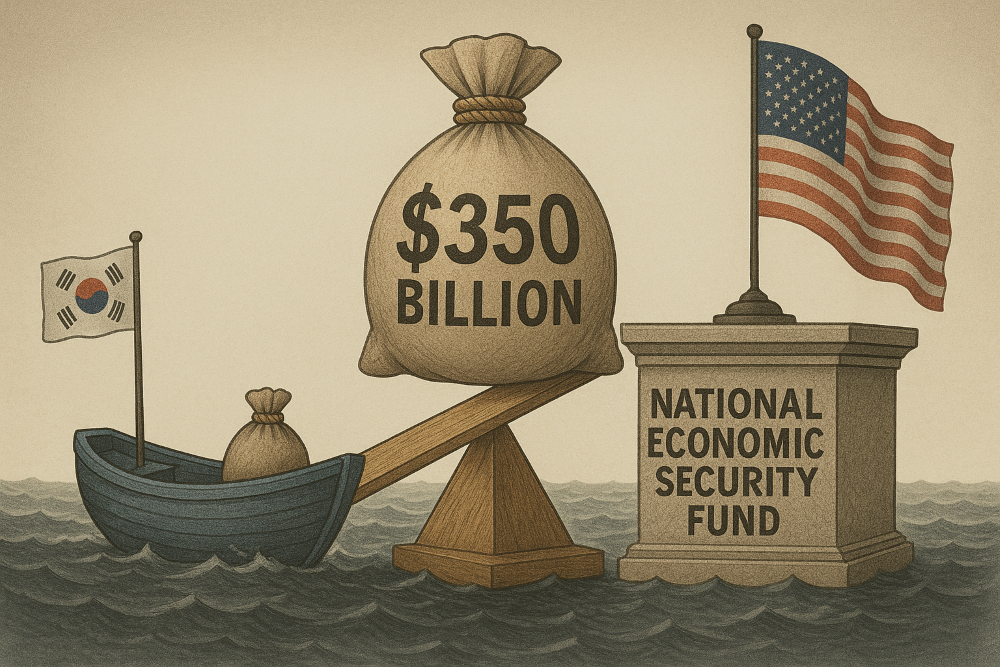
- The U.S. shift from a formal sovereign wealth fund to the improvised National Economic Security Fund (NESF) pushes structural and political risks onto Korea, despite its unprecedented $350 billion investment pledge.
- Because NESF is an executive-driven mechanism with weak governance and wide U.S. discretion, Korean capital may be funneled primarily toward U.S. supply-chain priorities with limited safeguards or reciprocal benefits.
- Korea must now convert a vague MOU into tightly negotiated, project-level agreements—built on commercial viability, risk-sharing, and enforceable protections—to avoid an asymmetric, high-exposure arrangement.
When President Donald Trump first floated the idea of
creating a U.S. sovereign wealth fund (SWF), it was framed as an ambitious plan
to build one of the world’s largest state-backed investors. That vision was
formalized on February 3, 2025, when he signed Executive Order 14196, directing
the Treasury and Commerce Secretaries to submit within 90 days a plan to
establish a U.S. sovereign wealth fund that would “establish economic security
for future generations” and bolster U.S. economic and strategic leadership.
However, as the agencies began working through the details,
the proposal ran head-on into legal, fiscal, and political constraints:
persistent budget deficits, the need for congressional approval, and
long-standing rules such as the Miscellaneous Receipts Rule that limit the
executive branch’s ability to sequester federal revenues into a standalone
fund. By late August, the shift became explicit. In an August 26 interview with
CNBC, Commerce Secretary Howard Lutnick stated that the administration would not
“start with” the sovereign wealth fund envisioned in February, but instead
would move first to create a National Economic Security Fund (NESF) financed
largely by investment pledges from allies such as Korea and Japan. In practice,
what emerged from this process was not a conventional SWF, but a pivot toward
this new NESF construct.
The problem is that the vagueness and instability of this
new framework effectively shift the risks of that ambiguity onto Korea, which
has pledged an enormous $350 billion investment package.
1. A Fund in Name Only: NESF’s Structural Limitations
The Trump administration initially envisioned a mega-fund on
par with Saudi Arabia’s Public Investment Fund (PIF). However, given the United
States’ massive fiscal deficits, the near-impossibility of raising such sums
without congressional approval, and legal constraints such as the Miscellaneous
Receipts Rule (which requires federal revenues to be paid into the Treasury),
the creation of a “traditional” sovereign wealth fund quickly ran into trouble.
In response, Commerce Secretary Howard Lutnick announced
that the administration would instead launch a National Economic Security Fund
(NESF). The primary sources of this fund, as currently described by Commerce
Secretary Lutnick, would be investment commitments from allies such as Korea
and Japan, rather than direct U.S. tariff revenues.
This origin story makes NESF look less like a formal
sovereign wealth fund, and more like an ad hoc investment mechanism
designed to pull allied capital into U.S. strategic industries. As of now, the
NESF remains an executive-branch concept rather than a legislated fund, with no
clearly defined governance framework, little clarity on how capital would be
raised and deployed, and no robust safeguards against political interference.
In this form, an NESF-type vehicle would be highly vulnerable to arbitrary political
influence. Carnegie researchers warn that, in general, sovereign funds
operating largely outside normal budgetary controls can become ‘founts of
corruption’ and de facto political slush funds. American Enterprise Institute(AEI)’s
op-ed has also gone so far as to describe it as an “cronyism slush fund.”
2. The Korea–U.S. Strategic Investment MOU: A Heavy
Burden in an Asymmetric Deal
Korea’s pledged $350 billion investment package in the United States is identified as one of the core funding pillars of the NESF concept. Measured as a share of GDP, this is an even heavier burden than Japan’s $550 billion commitment, and the agreement has triggered domestic criticism in Korea as a “humiliating, unequal treaty.”
At its core, this negotiation reflects Washington’s strategy
of leveraging allied capital to strengthen U.S. advanced industries and its
supply-chain security at a time of severe fiscal constraints. The targeted
sectors are semiconductors, critical minerals, artificial intelligence (AI),
energy, shipbuilding, and other “strategic industries” designated by the United
States.
Korea did secure some concrete gains: a cut in U.S. auto
tariffs from 25% to 15%, and an annual investment cap of $20 billion. But all
of this rests on an MOU, which by its nature has weak legal enforceability. The
United States, by contrast, is clearly positioning NESF as a vehicle to rigidly
entrench its economic security agenda as a foreign-policy priority.
3. Implementation Prospects: Why Pessimism Is Hard to
Avoid
The combination of an unstable U.S. fund architecture and
Korea’s massive investment pledges makes the implementation outlook for the
Korea–U.S. strategic investment MOU inherently bleak.
Maximization of U.S. Discretion in Fund Management
NESF, by design, is likely to be managed under the broad banner of
“economic security,” with the U.S. administration exercising wide discretion
over how funds are deployed. As Korean documents themselves acknowledge, the
United States has shown a strong desire for “discretionary management” of the
fund, leading to the assessment that “it will not be easy for the Korean side
to secure its demands in the course of negotiating individual investment
projects going forward.”
Exposure to U.S. Political Volatility
NESF is being advanced more as an executive initiative than as a construct
underpinned by solid congressional legislation. This means its structure and
investment priorities could shift abruptly with changes in the U.S. political
environment—whether through an administration change or a policy reversal.
Korea cannot rule out the possibility that its $350 billion commitment becomes
a tool for a particular administration’s political messaging, or is channeled
into projects shaped by domestic political influence.
Difficulty Securing Tangible Benefits for Korea
Korean firms will undoubtedly gain investment opportunities in the U.S.
market, including access to tax credits and incentives. However, if the
projects prioritized by NESF are primarily designed to stabilize U.S. supply
chains and bolster U.S. industrial competitiveness, it will be extremely
difficult for Korea to secure a balanced rate of return, meaningful technology
sharing, or robust joint R&D. There is a high risk that Korean capital will
simply be used to “fill a bottomless barrel” in U.S. strategic sectors.
4. Conclusion: From a Loose MOU to Structured Projects
In conclusion, the Korea–U.S. strategic investment MOU is
highly likely to become a high-risk arrangement in which Korea commits massive
resources to a deeply political and uncertain project labeled “U.S. national
economic security.” The question is no longer whether Korea will participate,
but on what terms and under what safeguards its participation will be
structured.
Rather than stopping at a loose MOU, the Korean government
should use every subsequent stage of project selection and implementation to
harden the framework. That means insisting on clear legal and institutional
protections that link each major investment project to enforceable commitments
on capital recovery, predictable tax and regulatory treatment, and credible
dispute-settlement mechanisms. Korea should prioritize projects that (i)
generate commercially viable returns, (ii) deliver tangible benefits to Korean
firms—such as technology sharing, joint R&D, or supply-chain
diversification—and (iii) include meaningful U.S. co-investment and
risk-sharing, rather than relying solely on Korean capital to fill U.S.
strategic gaps. At the same time, Korea cannot afford to move so cautiously
that it cedes initiative to Japan: Seoul will need to negotiate prudently with
Washington while closely tracking Tokyo’s project choices and sequencing, and
then move quickly enough to secure terms that are at least comparable, and
where possible more favorable, than those obtained by Japan.
Practically, this requires a project-by-project filter:
avoiding politically driven “flagship” projects with weak fundamentals; phasing
large investments with clear milestones and exit options; and embedding
governance provisions that shield Korean investors from abrupt policy swings in
Washington. Only by turning the MOU into a sequence of tightly negotiated,
well-structured projects can Korea reduce the asymmetry of the deal and protect
its long-term national and corporate interests. The $350 billion voyage has
only just begun, but whether Korea sails into a storm or into a more balanced
partnership will depend on how rigorously it manages the next round of
investment decisions.