Key Takeaways:
- President Lee’s E.N.D. policy repackages familiar progressive sequencing—exchange, normalization, then denuclearization—but does little to reflect how fundamentally North Korea’s posture has changed since 2019.
- Pyongyang no longer accepts denuclearization as a negotiating horizon and has redefined inter-Korean relations in ways that old formulas and new slogans cannot reverse.
- As Lee encourages Trump’s “peacemaker” instincts, Seoul’s most urgent task is not rebranding policy but shaping U.S.–ROK alignment ahead of any U.S.–DPRK talks, lest peace be negotiated on terms that marginalize South Korea’s core interests.
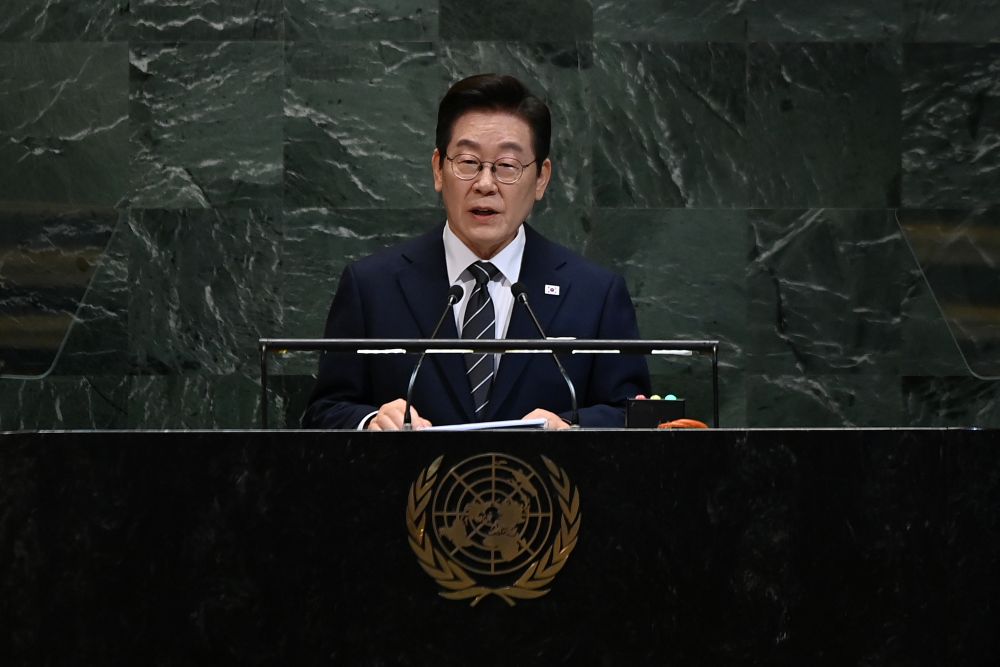
If there’s one thing Korean politics does well, it’s catchy phrases and loaded acronyms. President Lee Jae Myung’s encouragement of US President Donald Trump to be the “peacemaker” on the Korean Peninsula and offering to be the “pacemaker” to the process was a clever turn of phrase, appealing to Trump’s self-perceptions while trying to preserve a place for South Korea in any potential US-North Korea interactions.
Lee’s later announcement of his E.N.D.
policy toward North Korea was a convenient sound bite to describe his
“Exchange, Normalization and Denuclearization” roadmap. But there is little new
to the approach from what previous progressive administrations have pursued. While
this sequencing might have worked in the past to varying degrees of success, the
geopolitical conditions have fundamentally changed since the last round of
inter-Korean and US-North Korea talks ended. Recycling this old formula is unlikely
to move the needle with Pyongyang and is more likely to end with Seoul getting
sidelined – or side swiped – if Trump and Kim Jong Un resume talks in the
future.
Lee seems to be already recalibrating,
especially retooling how denuclearization fits into the equation, to account
for this reality. However, renaming the policy will only go so far. Given how
North Korea’s vision of peace on the Korean Peninsula appears to be shaping up,
more work needs to be done to build mutual understanding within the US-ROK
alliance to help shape the agenda of any future US-DPRK talks.
The New Operating Environment
The END initiative is premised on the idea that sequencing
is the key to success. Rather than the previous Yoon Seok-yul administration’s
assertion that North Korea’s denuclearization could lead to normalized
relations and robust benefits, Lee has laid out a path where gradual
improvement of relations is possible in the near term, through exchange and
peacebuilding, creating the conditions where denuclearization is possible in
the long term.
This approach, however, is far from new. Past progressive
administrations followed this familiar pattern, starting with exchanges such as
family reunions and economic cooperation while working to lower the risks of
war and build the foundations of a sustainable peace regime. Denuclearization
would be part of that peace regime, with the prospects of unification sometimes
more or less prominent as the long-term measure of success.
While this sequencing makes sense and was once endorsed by
North Korea, it requires having a willing partner in Pyongyang and
international cooperation to achieve. In 2018, Kim Jong Un was, in fact,
willing to negotiate around his nuclear weapons program to accommodate broader
security and economic goals. Moon Jae-in also found Trump to be an unexpected
partner, breaking the historic refusal of a sitting US president to engage a
North Korean leader directly to try to leapfrog negotiations forward.
That combination of personalities, with general support for
the negotiation process from China and Russia as well, created a unique window
of opportunity to engineer a breakthrough in relations. But even under those
conditions, the US and North Korea couldn’t agree on what a mutually acceptable
first step should be and the process ended almost as abruptly as it started. At
the same time, inter-Korean exchange cooperation were severely hampered by
sanctions, unable to move forward with the commitments made in the Panmunjom
Declaration as well. Moreover, there seemed little support from the US, despite
its improving relations with Pyongyang, or the international community to give
Seoul space to maneuver within the sanctions regime without first securing concrete
actions on North Korean denuclearization.
One lesson Kim Jong Un appears to have learned from that experience
is that there is no longer an inter-Korean agenda that can be pursued
independent from North Korea’s relations with the US or international community
– relationships that are largely contingent on the nuclear issue. Kim had urged
Moon multiple times in 2018 and 2019 not to let external actors interfere in
inter-Korean affairs, but Moon’s hands were tied without sanctions exemptions
and the goodwill eventually led to disappointment and North Korean resentment.
Since 2019, North Korea has severed ties with the South, denounced
a shared goal of peaceful unification, disbanded institutions that managed North-South
relations, denied shared kinship still exists, and codified into law South
Korea as a separate and hostile state. This is not just a policy shift, but a
fundamentally new stance on peninsular relations – one that is not going to be reversed
by an old approach dressed up in a new catchphrase.
Furthermore, even in potential dealings with the United
States, North Korea has made clear
that any negotiation process contingent on denuclearization – whether at the
beginning or the end – will be rejected. While Kim Jong Un has said there is a
reason for two states with nuclear weapons not to have confrontational
relations, he appears to be in no rush to resume talks with Trump, and
especially not about his nuclear weapons program. This raises important
questions about what future talks between the US and DPRK would focus on. This
should be especially concerning to Seoul, as they encourage Trump to follow his
so-called peacemaking instincts with Kim Jong Un.
What Next?
Lee has shown a willingness to modify the language of his
E.N.D. policy away from the term denuclearization, which is politically charged
and has historically implied the unilateral disarmament of the North, to a more
neutral term of “nuclear-free
Korean Peninsula” to accommodate a potential diplomatic opening. This is
not a new term in inter-Korean relations, as it was used in the Panmunjom
Declaration as well, as the end goal of denuclearization.
This recalibration of language might have been useful under
past conditions, but it is unlikely to be particularly compelling in the
present. Not only is North Korea seemingly uninterested in negotiating about
its nuclear program, but the term seems disconnected to South Korea’s own
actions these days. Since 2018, the US and South Korea have deepened alliance
cooperation on nuclear planning and conventional nuclear integration, as
delineated in the Washington
Declaration, to the extent it is touted as a “nuclear
alliance” with growing discussion of further measures such as nuclear
sharing. More recently, South Korea’s push for nuclear
latency—including nuclear powered submarines,
and enrichment and reprocessing rights—appears to be making slow progress.
These actions seem at odds with a policy what would be expected from a country
working toward a “nuclear-free Korean Peninsula.”
More importantly, Lee’s encouragement of Trump to be the
“peacemaker” for the Korean Peninsula creates a real possibility that future
US-DPRK talks will focus on defining that peace. North Korea is undoubtedly
learning from current Russia-Ukraine peace negotiations and planning
accordingly. Should Kim resume talks with Trump, he is liable to come to the
table with his own plan, one that naturally caters to North Korean interests
and presents a very different vision of peace on the Korean Peninsula. This is unlikely
to be the symbolic “end of war” declaration request from past negotiations but will
probably push for something more substantial that endorses the permanent
division of the Korean Peninsula, permanent sovereignty, North Korean-defined
borders, and potentially even the dissolution of legacies of the Korean War
such as the DMZ. This kind of an agenda will fundamentally call into question
the legitimacy of South Korea’s territorial claims at the very least and could
even impact how the US or international community views South Korea’s continued
push for unification.
Therefore, changing the name of the policy may be useful for facilitating potential diplomatic opportunities, if the final formulation conforms with broader policy aims and actions. But the more urgent task for the Lee administration seems to be building a deeper mutual understanding within the US-ROK alliance ahead of any US-DPRK talks, establishing some parameters of what should (and shouldn’t) be negotiable, and helping shape what Trump’s “peacemaker” vision for the Korean Peninsula should be.
Jenny Town is a Senior Fellow at the Stimson Center and the Director of Stimson’s Korea Program and 38 North. Her areas of expertise include North Korea, US-DPRK relations, US-ROK alliance relations and extended deterrence, and Northeast Asia regional security. She was named one of Worth Magazine’s “Groundbreakers 2020: 50 Women Changing the World” and one of Fast Company’s Most Creative People in Business in 2019 for her role in co-founding and managing 38 North, which provides policy and technical analysis on North Korea. Ms. Town is also an Associate Fellow at the Foreign Policy Institute at Johns Hopkins School of Advanced International Studies (SAIS), a Member of the National Committee on North Korea, and an Associate Member of the Council of Korean Americans. She serves on the Editorial Board for Inkstick, an online foreign policy journal for emerging scholars. She previously served as the Assistant Director of the US-Korea Institute at SAIS (2008-2018) and an expert reviewer for North and South Korea for Freedom House’s Freedom in the World Index (2010-2023), where she previously worked on the Human Rights in North Korea Project. Ms. Town holds a BA in East Asian Studies and International Relations from Westmar University and a Master of International Affairs from Columbia University School of International and Public Affairs. She is a frequent commentator for a range of print, radio and television news, including Reuters, BBC, CNN, Financial Times, Deutche Welle, Voice of America, Japan Times, NHK, CGTN, BBC World Radio, and more. And has been featured on a number of podcasts including Asia Matters, The President’s Inbox, the Impossible State, Today Explained, The DSR Daily Brief, and more.