- #ROK–U.S. Alliance
- #Security & Defense
- #US Foreign Policy

Key takeaways:
- The key outcomes of the 57th ROK–US SCM demonstrate the agreed-upon direction of alliance modernization.
- The ROK has agreed to increase defense spending to reach 3.5% of GDP and has acquired US approval to build a nuclear-powered submarine and seek ways to enrich fuel for civilian use.
- How strongly the United States intends to deter China and to what extent allies will be mobilized remains a key question for alliance modernization.
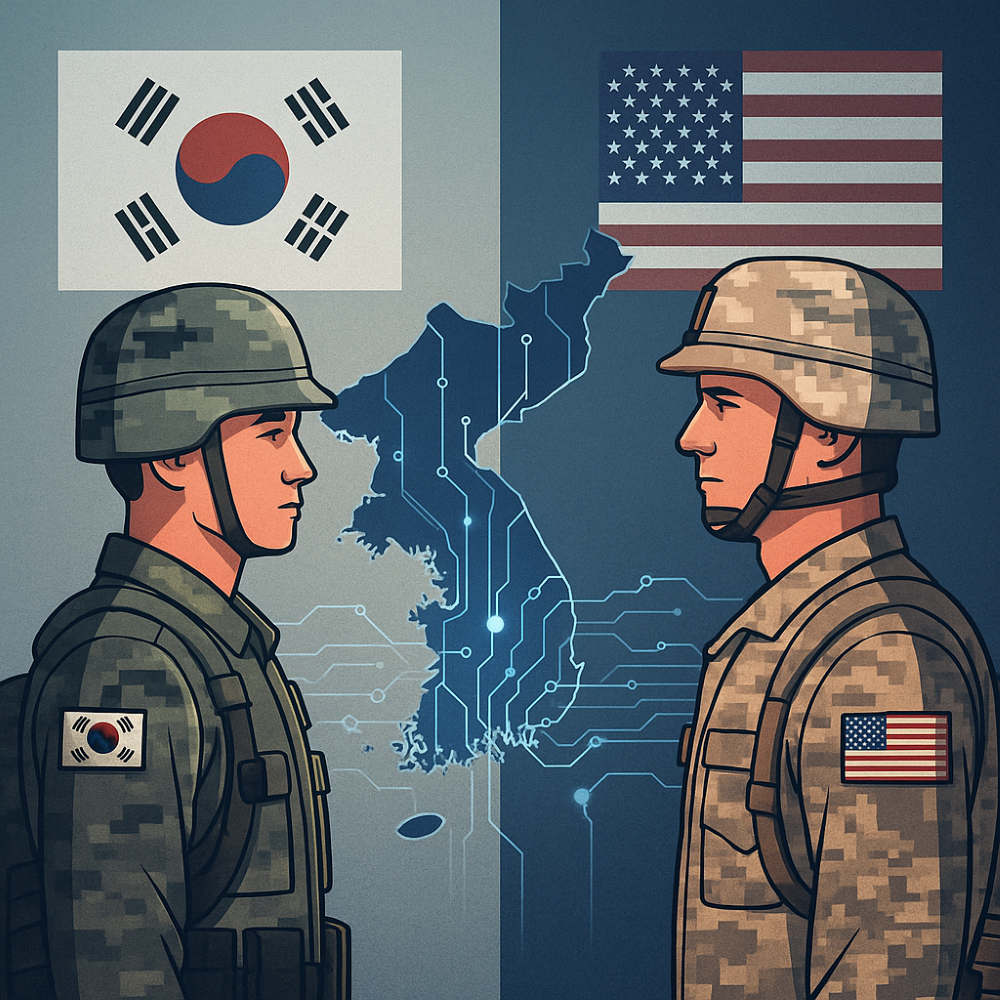
The second ROK-US Summit held on the sidelines of the APEC Summit and the 57th ROK-US Security Consultative Meeting(SCM) that followed demonstrated that the United States and the Republic of Korea are determined to build a future-oriented, comprehensive strategic alliance. Alongside tariff negotiations, the two parties have agreed on a basic framework of alliance modernization to reflect the demands of a rapidly changing security environment. The Trump administration favors strong allies and is thus pursuing the modernization of the ROK-US alliance in a comprehensive manner. In defense, it aims to deliver tangible outcomes that include enhanced interoperability and cross-domain cooperation, as well as expanded deterrence capabilities that reach beyond the Korean Peninsula.
Yet, the ROK and United States hold subtly different interpretations of what alliance modernization entails based on their respective “core national interests.” As the United States seeks to reset its grand strategy towards retrenchment and prioritization to gear up for a “dangerous decade,” rebalancing the alliance and strategic alignment have become a prerequisite for its version of alliance modernization. The former refers to making allies spend more on their own defense, carry out proactive missions, and play a hands-on role in regional security. The latter asks allies to step in line with the United States in deterring China on military, economic, and technological fronts.
In reaction, the ROK seeks to turn U.S. demands to its advantage, not only by deepening bilateral alliance cooperation, but also by pursuing self-reliance and building networked ties with a more diverse set of partners to expand its outreach. In a sense, the alliance modernization narrative functions as a a vehicle through which both parties can pursue mutually beneficial policy outcomes. A consensus on what constitutes successful ROK–U.S. alliance modernization is emerging and must take into account the regional and global implications of such efforts.
What America Wants
The Trump administration is unapologetic about its determination to cut costs, reduce the risk of entrapment, and optimize its alliance relationships to effecitvely mobilize the resources needed to win the strategic competition against China. The unilateral demands for alliance rebalancing that characterized the first Trump administration were smoothed out during the Biden administration with diplomacy, but the tone was consistent. The idea that allies should no longer take advantage of the U.S. and must do more burden sharing is now welcomed in a rare bipartisan manner. Particularly, the Trump administration perceives the ROK-U.S. alliance in light of America First 2.0. It emphacizes the value of the alliance through the prism of homeland defense, geoeconomics and reciprocity. To concentrate on homeland defense that prioritizes border security and tighter control over the western hemisphere, the United States needs the ROK to take full responsibility of its conventional defense and for the U.S. Forces Korea to be more capable and agile. Geoeconomic needs call for enhanced industrial and technology cooperation in shipbuilding, semiconductors, critical minerals, AI and so forth. Citing reciprocity, the United States has imposed significant tariffs despite the U.S.-Korea Free Trade Agreement and has struck deals for Korean firms to invest in the US and offer wider access to the Korean domestic market.
The United States recognizes that a strong economic foundation is necessary for sustainable military overmatch and is reigning in on its alliance networks. The National Security Strategy(NSS) 2025 underscores that economic and technological dominance are key to national security. That is, the United States will leverage advanced technology cooperation, weapons sales and access to its capital markets for greater burden sharing of allies. Put bluntly, U.S. security assistance to allies is now being conditioned on alliance contributions and alignment.
What the ROK Wants – Challenges and Opportunities
The Lee Jae Myung administration perceives the ROK-U.S. alliance in a new light of national interest-based pragmatism. The alliance’s geopolitical value of deterring North Korea and maintaining peace and stability in the region continues to be a priority. However, geoeconomics has become more prominent as the ROK and U.S. seek to bolster each other’s critical industries and create a resilient supply chain for the long haul. Above all, self-reliance within the structure of the alliance is crucial for Seoul, where bilateral cooperation with the United States in advanced technology and the defense industry base is vital to expand indigenous defense capabilities and arms exports. As a result, the ROK has incentives to construct its version of alliance modernization following its own national priorities.
The key outcomes of the 57th ROK-U.S. SCM demonstrate the agreed upon direction of alliance modernization. First, the parties secured legitimacy for expanding the ROK’s leading role in national defense as well as strengthening the capabilities of the ROK Armed Forces in defense of the Korean Peninsula. Second, it outlined concrete procedures to advance the conditions-based wartime OPCON transition and provided a foundation to accelerate the ROK’s acquisition of necessary capabilities. Third, recognizing the contributive role of U.S. Forces Korea (USFK) towards peace on the Korean Peninsula and the region, the allies pledged to sustain USFK’s force levels. Fourth, the allies specified cooperation measures on shipbuilding as well as maintenance, repair, and overhaul (MRO), which symbolizes a future-oriented, comprehensive strategic alliance. Accordingly, the ROK has agreed to increase defense spending to reach 3.5% of GDP and has acquired U.S. approval to build a nuclear-powered submarine and seek ways to enrich fuel for civilian use.
However, the regional security linkage elements embedded in the ROK-U.S. Summit fact sheet and SCM joint communique suggest there are sensitive items that working-level officials will need to navigate with care. The fact that the ROK and U.S. assess the value of the ROK-U.S. alliance via a more nationalistic and interest-oriented lens offers both opportunities and challenges. In broad strokes, the Lee and Trump administration are both pragmatic and far from ideological. Hence, they are highly compatible on issues such as expeditious OPCON transfer and defense industry base cooperation, where U.S. interests to reduce costs and entrapment risk align with ROK interests to enhance self-reliance. However, the issue of modifying the scale, mission or role of the USFK strategic flexibilty will be contentious as interests are less compatible. In addition to entrapment risks, the ROK’s determination to resuscitate relations with China and the DPRK will empower calls for self-reliance. Moreover, tensions could rise when a new round of SMA negotiations begin and the U.S. asks for a significant increase in ROK contribution regardless of already pledged defense expenditure increases.
How strongly the United States intends to deter China and to what extent allies will be mobilized remains a key question for alliance modernization. The NSS 2025 demonstrated tactical maneuvering by softening the tone against China and other security threats in general. However, the soon-to-be released National Defense Strategy(NDS) may well reflect the stronger undertones of a strategy of denial and may request concrete action. Above all, enhanced U.S. military posture in the western hemisphere may accelerate the rotation of or even draw down certain US forces deployed in Northeast Asia as well as the Indo-Pacific region, creating an immediate burden for the ROK.
Tasks Ahead
Two issues need to be dealt with extra care. First, material cost-sharing within the alliance. Although the ROK pledged expeditious defense-spending increases based on domestic law, the U.S. may attempt to influence the implementation of the pledged $25 billion in U.S. weapons purchases through 2030 and $33 billion in comprehensive support for USFK. In such a case, the ROK would need to hold firm by emphasizing defense-spending increases grounded in security and commercial rationality, while offering a public explanation of how exactly defense spending will increase.
Second is role-sharing within the alliance. The Summit fact sheet states that the ROK and U.S. will strengthen the U.S. conventional deterrence posture “against all regional threats including North Korea.” It also acknowledges the shared understanding of strategic flexibility agreed in 2006, which implies increased utilization of the USFK. Consequently, the U.S. could pose requests that may trigger sensitive Chinese reactions such as additional deployments of offensive weapons in the region or expanded joint ROK-U.S. military exercises. It is important to distinguish between the ROK military’s focus on Peninsula defense and the USFK’s role that can contribute to deterring China, while sustaining separate strategic dialogues with China and Japan. The region also faces complex threats stemming from DPRK–Russia cooperation, so the discourse should not be narrowly fixated on China alone.
Continued interagency consultations will also be needed regarding the ROK-U.S. leaders’ agreement on the construction of a ROK nuclear-powered submarine and provision of nuclear fuel supply. There are both internal and external disagreements over its feasibility, strategic necessity, and the potential to intensify regional arms competition. Above all, building a nuclear-powered submarine requires significant investment for future hard power, making it essential to set a final objective and establish a sustainable plan. Because operating nuclear-powered submarines entails nonproliferation responsibilities, public diplomacy to persuade and reassure partners in Asia and Europe is critical. As reflected in recent remarks by the US Navy’s top leadership, U.S. expectations of the ROK are already high. For alliance modernization to succeed, the ROK will need to make prudent decisions about the alliance’s regional role while maintaining a firm defense posture on the Korean Peninsula grounded in strengthened national defense capabilities.
Dr. Bo Ram Kwon is a Research Fellow at the Korea Institute for Defense Analyses (KIDA), a government-funded defense think tank in Seoul. Her research area includes U.S. security and defense strategy, the ROK-U.S. alliance, the nexus between U.S. foreign policy and American politics, and economic sanctions. She holds a B.A. in political science and business administration from Ewha Womans University and an M.A. in international relations from Korea University. She received her Ph.D. in political science from the University of North Carolina at Chapel Hill, USA.